
Showing posts with label Strategies. Show all posts
Showing posts with label Strategies. Show all posts
Monday, March 31, 2014
Resource for activities
Need ideas for activities for children of different ages? The website www.pecentral.org has a huge variety of lessons that can be used/modified by instructors and therapists. We use a lot of those for intervention with a very specialized group, and the website is great to give us a general idea of how to start and how we can propose some of the motor skills. It's a great resource for everybody who works with movement somehow.

Cues for motor skill learning
A little while ago a student came to my office to ask me what he could do to help his students learn the correct "stances" for martial arts. I don't know anything about martial arts, but I know a little about how children learn skills. So I ask him to show me what he was talking about. Basically, he showed me a couple positions that were not difficult (for an adult), but were also not symmetric or made a lot of sense. He said he had a lot of problems with feet placement - while he would fix one child's foot, the other foot moved out of the correct position, and so on. I told him to use two color tapes (one for the front and another for the back foot) and tape them on the ground exactly in the position that the child should be, so they would have to step on the tapes instead to think of the stances. He doubted a bit but said he'd try. In a week, he came back to tell me the "miracle"- he didn't have to waste any more time on the stances, they all got it!

I wish I was the one performing "miracles" all around, but unfortunately, I only used a very old technique to help with skill learning: The use of cues (or labels). Cues are cognitive strategies that describe a particular aspect of a concept or skill (usually the key aspect) and enable children's performance by enhancing attentional focus, facilitating information processing, and assisting with retention and retrieval of information. It's an extremely easy and even fun concept to use with children, and the benefits are gigantic. But to my surprise, very few people use them or even know the benefits. I've seen countless of therapists and instructors describe movements with a lot of detail and demonstrate skills without even specify what the child should be paying attention to or simplifying the concept (imagine creating a cue!).
The most commonly used cues are of the verbal type, but in motor skill learning we can use visual and kinesthetic cues. In my classes, every time students have to propose an activity, I ask them to 1) identify the critical aspects of the movement and 2) create different types of cues for each aspect. It helps them understand the movement and to think of what is meaningful for a child, too. Here is a simple example of using hula hoops so the kids now where their feet go. Easy, huh?

What about you? Do you use cues for learning? What are some that work?
I wish I was the one performing "miracles" all around, but unfortunately, I only used a very old technique to help with skill learning: The use of cues (or labels). Cues are cognitive strategies that describe a particular aspect of a concept or skill (usually the key aspect) and enable children's performance by enhancing attentional focus, facilitating information processing, and assisting with retention and retrieval of information. It's an extremely easy and even fun concept to use with children, and the benefits are gigantic. But to my surprise, very few people use them or even know the benefits. I've seen countless of therapists and instructors describe movements with a lot of detail and demonstrate skills without even specify what the child should be paying attention to or simplifying the concept (imagine creating a cue!).
The most commonly used cues are of the verbal type, but in motor skill learning we can use visual and kinesthetic cues. In my classes, every time students have to propose an activity, I ask them to 1) identify the critical aspects of the movement and 2) create different types of cues for each aspect. It helps them understand the movement and to think of what is meaningful for a child, too. Here is a simple example of using hula hoops so the kids now where their feet go. Easy, huh?
What about you? Do you use cues for learning? What are some that work?
Monday, February 24, 2014
Motor intervention for children: Activity ideas
The best part of my week is the time I spend with children in a group intervention program that is specifically aimed for children with Developmental Coordination Disorder (DCD). I'll talk a little bit more about that some other time, but for now I'd like to show the activities we used in today's intervention session. It was a blast!
1. Catching Pokemon
This was such a hit! Children hold a "fishing pole" that has a magnet on the end - we have two sizes, a really long one and a shorter, which is always easier. Children are seated on a scooter and they have to catch one Pokemon at a time (there was a clip on the image) and bring it back to the table, one at a table. After that, they had to copy the names of the Pokemon on their list. There are many challenges - staying on the scooter, fishing, using non-dominant arm, and of course, writing.


2. Body tracing
Another cool activity - in pairs, one child laid down on a long and wide piece of paper, and the partner traced their upper body. After that, they got to decorate in order to create a "doll" version of their partner.


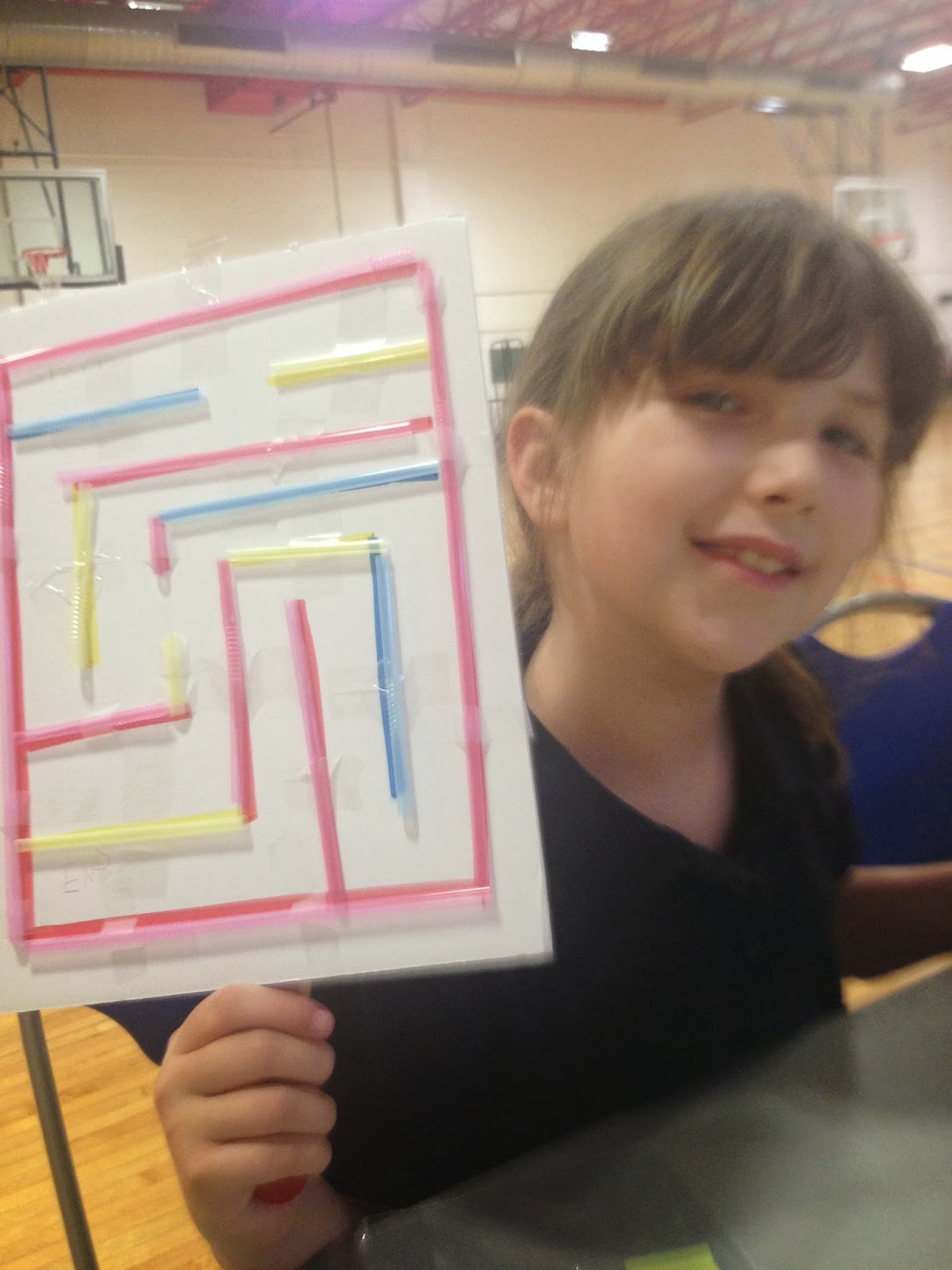
4. Straw maze
Another hit! With the lines setup for a paper on a piece of paper, children pick up straws cut in different sizes (set for fitting the maze) and use scotch tape to stick them to their respective places. That's a challenge in itself for children with fine-motor coordination problems. Then they get to use the maze to roll a marble ball - and it works perfectly!


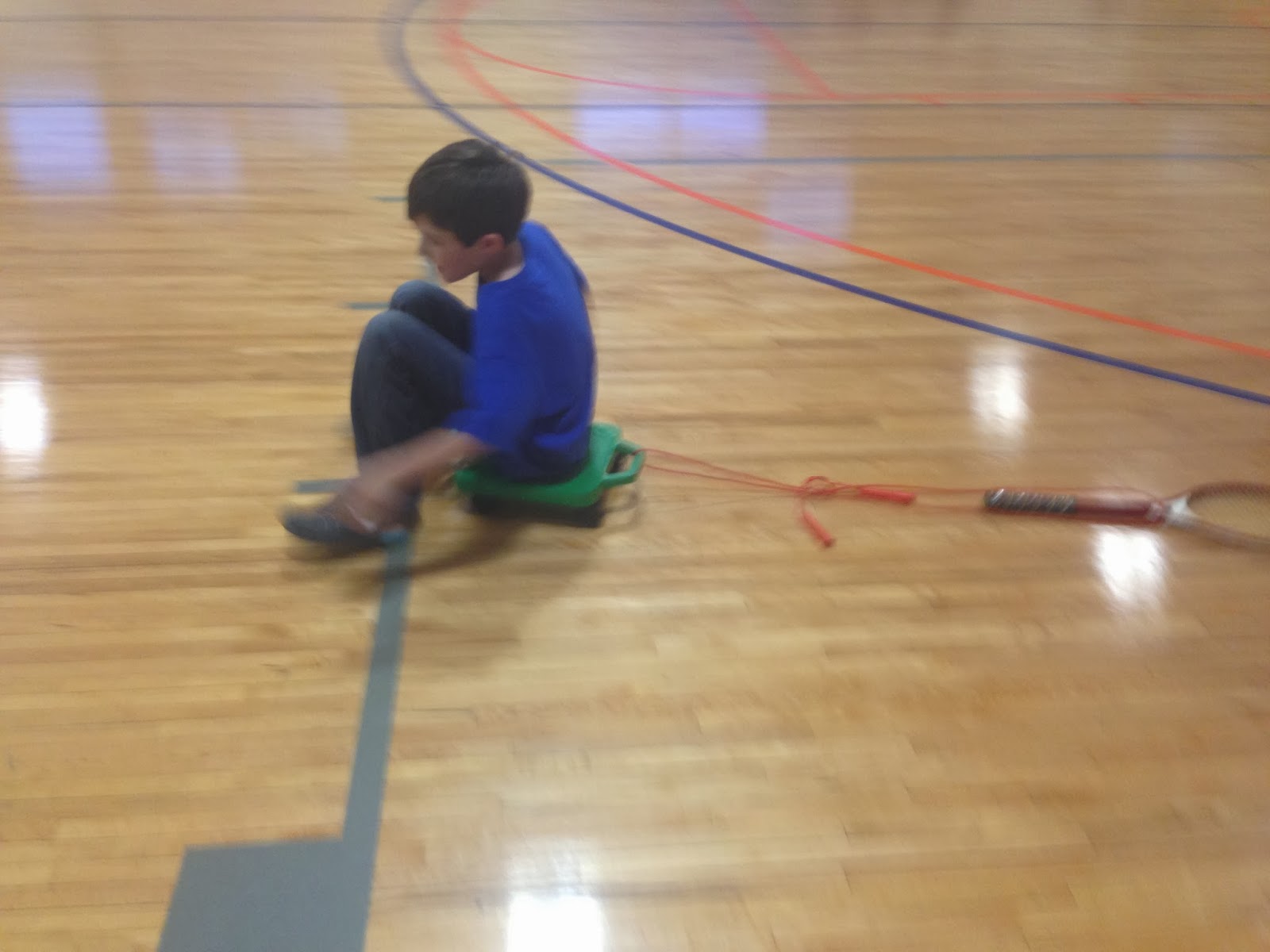
 5. Scooter relay
Children had to tie a racquet to a scooter (they practiced several types of knots with a large rope some time ago), take them to the other side of the place, then untie it. After that, they were supposed to complete a couple tasks such as balancing the tennis ball on the racquet in one position and dribbling a basketball on a few targets.

Some strategies for success:
- Use checklists - the children I work with enjoy receiving a list of their activities/goals in the beginning of their sessions, and they get to check their accomplishments throughout the program.

- Always move the focus of the attention of the child to an external point - in this case, the goal is to hit the poly dot, not to focus on dribbling.

- Mazes are a great activity, but sometimes they can be too challenging - one thing that will make it easier is to actually focus on coloring the "no exit" areas - the path will be much easier to find then.

1. Catching Pokemon
This was such a hit! Children hold a "fishing pole" that has a magnet on the end - we have two sizes, a really long one and a shorter, which is always easier. Children are seated on a scooter and they have to catch one Pokemon at a time (there was a clip on the image) and bring it back to the table, one at a table. After that, they had to copy the names of the Pokemon on their list. There are many challenges - staying on the scooter, fishing, using non-dominant arm, and of course, writing.
2. Body tracing
Another cool activity - in pairs, one child laid down on a long and wide piece of paper, and the partner traced their upper body. After that, they got to decorate in order to create a "doll" version of their partner.
3. Balancing tennis ball on racquet
This is a pretty simple activity but that can be modified in many different ways - for example, the size of the ball changes the force required to hold it. Also, holding the racquet on the end or middle changes it as well. Children can try with their non-dominant arm, while walking, while balancing, kneeling and standing up, and if possible, dribble once and hold it. My suggestion is to practice this in a obstacle course, so children can explore all the different possibilities for this activity.
Another hit! With the lines setup for a paper on a piece of paper, children pick up straws cut in different sizes (set for fitting the maze) and use scotch tape to stick them to their respective places. That's a challenge in itself for children with fine-motor coordination problems. Then they get to use the maze to roll a marble ball - and it works perfectly!
Children had to tie a racquet to a scooter (they practiced several types of knots with a large rope some time ago), take them to the other side of the place, then untie it. After that, they were supposed to complete a couple tasks such as balancing the tennis ball on the racquet in one position and dribbling a basketball on a few targets.
Some strategies for success:
- Use checklists - the children I work with enjoy receiving a list of their activities/goals in the beginning of their sessions, and they get to check their accomplishments throughout the program.
- Always move the focus of the attention of the child to an external point - in this case, the goal is to hit the poly dot, not to focus on dribbling.
- Mazes are a great activity, but sometimes they can be too challenging - one thing that will make it easier is to actually focus on coloring the "no exit" areas - the path will be much easier to find then.
Subscribe to:
Posts (Atom)